What if you could master a subject overnight?
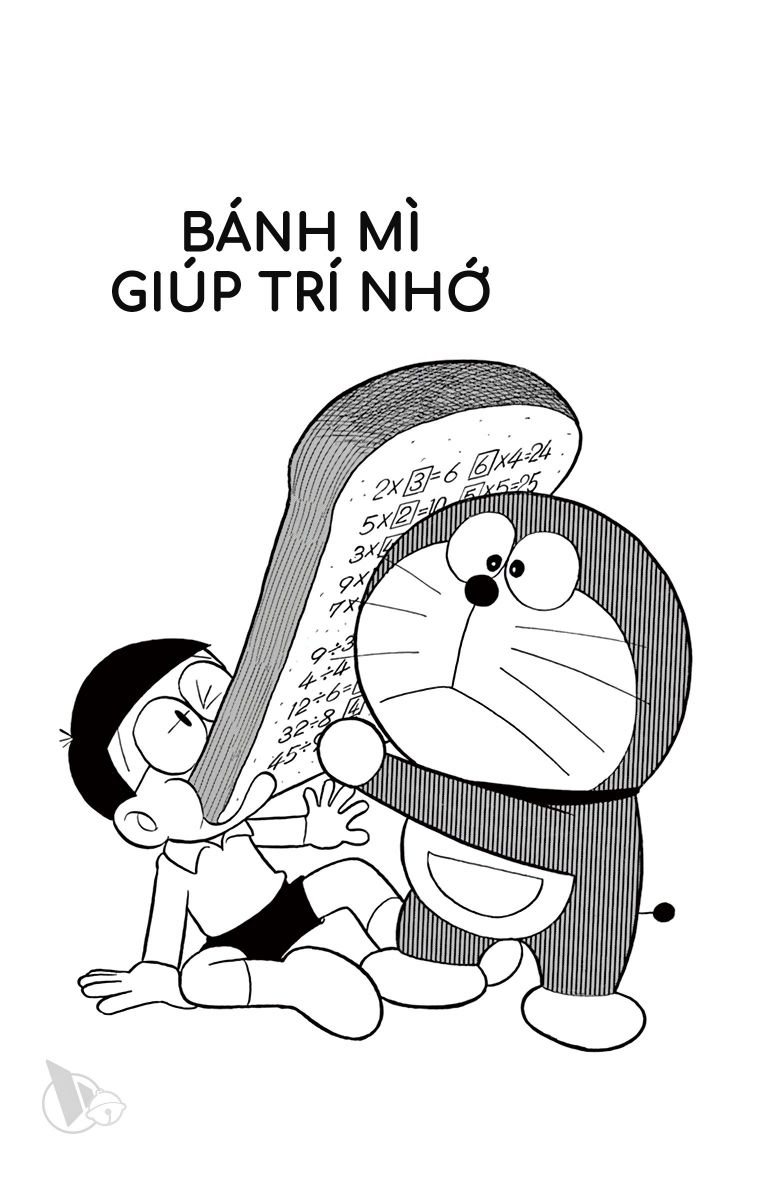
One of my favourite Doraemon’s invention is the bread to memorise. The story goes like this: during breakfast, just before exam, Nobita realized that he forgot to study for it. Doraemon offer the magic breads that can store the textbook content. By eating the breads, Nobita will remember the book. And with that, Nobita passed the exam with flying color, since he can recall everything from textbook perfectly.
It was a story during my childhood, and now with the evolution of AI, I feel it might be come true in the near future.
What if our brain can be augmented with AI in some shape or form that it can be embedded in our thinking process. Can we master something (i.e., “to pass an exam”) very quickly by just consuming the books? Or in the future, how much and how fast we (as human) can learn something? If so, the question is no longer “can I learn it?”, but rather “what am I learning it for?”
What does it mean?
We start first with the foundation layer of how our brain is organised by applying the framework of DIKW as follows:
- Wisdom – Synthesis – Strategic
- Knowledge – Skills
- Information – Organise, Label
- Data – Gather, Collect
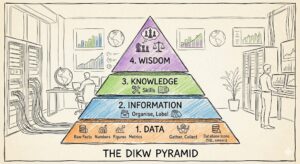
Our thinking and doing navigates between these layers. For example, you are preparing for a geography exam in high school:
- First, the geography textbook give you data (i.e., population density, city size) and information.
- While reading the book, you organise such data and connections into your “mind map” (i.e., “the city has a population of XYZ…”).
- You did some exam papers to build your skills or knowledge, such recall, calculate and validate certain information.
- As you are more competent with the skills, you might be able to build new narrative and make forecast strategically about certain cites development (e.g., you know the book “Prisoners of Geography”)
What’s next?
Now imagine that our brain is boosted with AI power, as an augmented brain, in capability to interact and to expand the width and depth of all layers – Data, Information, Skills and Wisdom – in our thinking process. For example:
- Data – delegate to AI
- Example: agent will do interview or crawl data online before an interview with candidates. Such data will be assessable when our brain is thinking about it.
- Information – use AI to label and organise information, build connections.
- Example: it happens in the background, like when we use NotebookLM to build mind maps. Or when vector databased and embedding are used to systematically store and retrieve information.
- Knowledge – in short, we want to build our skills effectively (and efficiently). AI can be used to train us: to recall, design test with desirable difficulty.
- Wisdom – now we want co-thinker, build new ideas
With this, very likely that we can learn and master faster than we are today, given how AI can be in the loop of our learning and thinking. Can this be a realistic future of the “memory bread”? That:
- Step 1: load DIKW to your brain’s AI → Such as when Nobita eats the “memory bread”.
- Step 2: brain’s AI build connections in our brain through learning techniques → Well, maybe this is when Nobita chews and digests the bread.
- Step 3: as we think (during exam or at work), every thinking process is supplemented and influenced by the brain’s AI → Just like how Nobita answers the exam questions with knowledge loaded from the bread.
Furthermore, today we might spend more time at Data and Information as compared to building Knowledge and Wisdom. With AI and the augmented brain, I foresee that the depth and width of our DKIW will expand, and we will focus more on Knowledge and Wisdom, than with Data / Information in near future.
4. What could be the drawbacks?
This paints a naive yet promising picture of how our learning and thinking capacity will be boosted when our brain is augmented with AI capability. So what could be the trade-off?
First, the cost. Human has many years of evolution and optimise our energy to learn and think. AI surely come with cost (e.g., energy). And maybe there will be cost in the interface of AI to brain (augmented brain) as well.
Second, the risks. In the story, we should assume the discerning and decision making power is still with us (individual / human). It will be a scary future if we lose our ability to think and discern, when our brain gets augmented with AI.
5. So What?
While this is an easy read, there are few key reflections for us today:
- In our daily thinking and learning and other activities, what can be augmented with AI? Remember: augmented, and not replaced.
- Does using AI already help to expand your information gathering or to automate repetitive stuffs?
- Can we use AI to boost our knowledge (or improve our skills)? Or help us think more strategically?
We must be more intentional with using AI in our thinking process. In the end, let’s remember Descartes’s quote – “I think, therefore I am” – “tôi tư duy nên tôi tồn tại”.